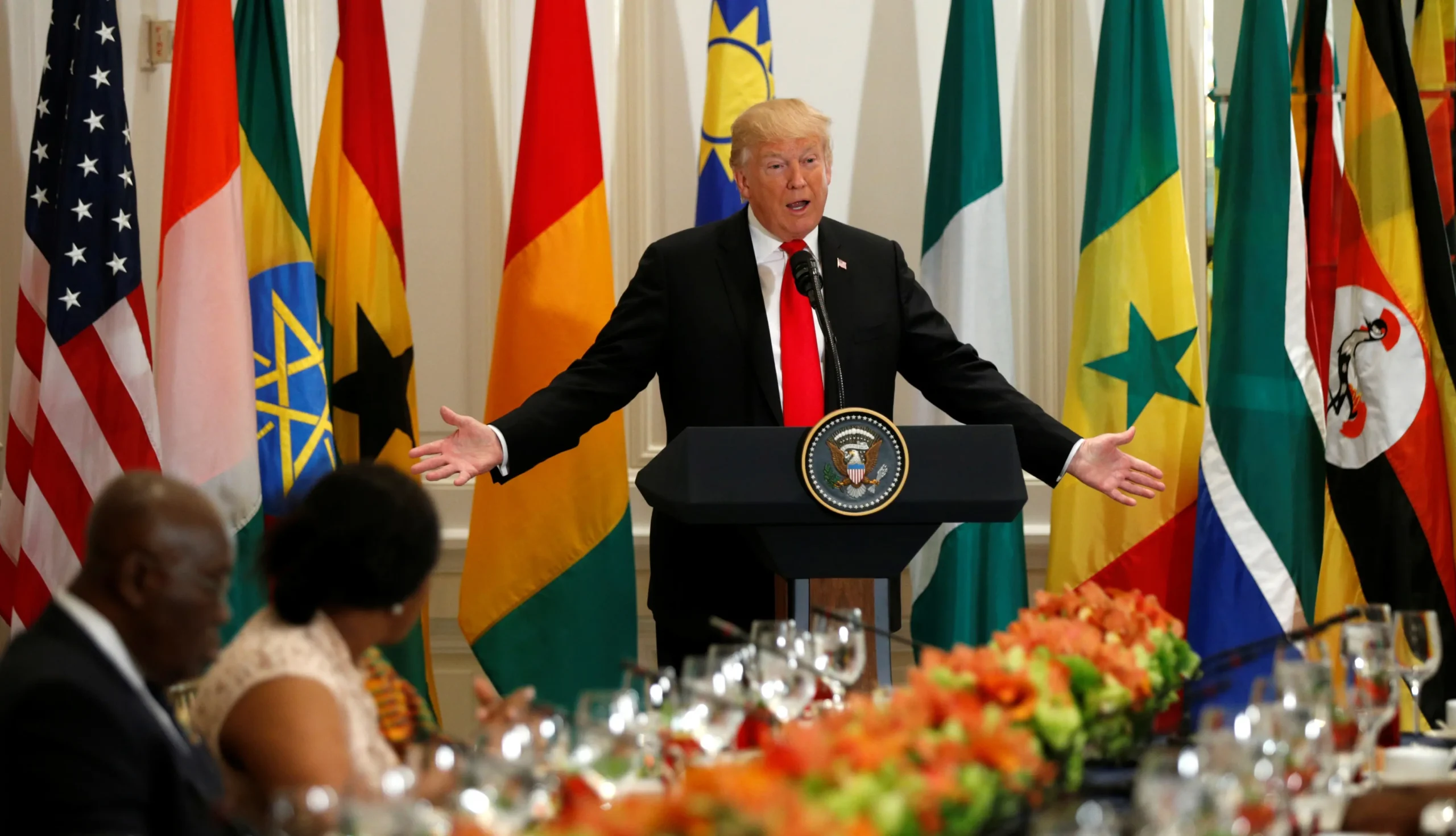
When former U.S. President Donald Trump recently claimed that Nigerian Christians were facing genocide, the reaction among Nigerians was intense and divided. Many Christians, judging by their names and comments, seemed to agree with him—perhaps out of faith-based solidarity. Others, including Muslims, dismissed the remark as exaggerated and divisive.
Yet, beyond the social media skirmishes and emotional exchanges, Trump’s statement reveals something deeper: a familiar pattern in the United States’ dealings with Africa. It is the weaponization of crisis narratives—whether framed as human rights violations, religious persecution, or authoritarianism—to justify interference, delegitimize leadership, and ultimately gain influence over the continent’s natural and strategic resources.
Trump’s sudden “concern” for Nigerian Christians is not an isolated outburst. It fits into a long history of American strategic communication, where moral rhetoric masks geopolitical ambition. The same method has been applied, with devastating consequences, in Sudan, Libya, and Egypt.
Sudan: Sanctions, Secession, and the Gold-Oil Equation
Sudan offers a textbook case of how Washington’s moral posturing often conceals material interests. Once oil was discovered there in commercial quantities, the U.S. shifted from engagement to isolation. In the 1990s, when Sudan drew closer to China for oil development, Washington retaliated by designating it a “state sponsor of terrorism.” Economic sanctions crippled Sudan’s economy for decades.
The Darfur conflict in the early 2000s was subsequently cast in U.S. media and diplomatic circles as “genocide”—a term with powerful emotional pull. While there were undeniable atrocities, the selective outrage conveniently weakened Khartoum and paved the way for further Western leverage.
In 2011, with U.S. backing, South Sudan seceded from the North. The event was hailed internationally as a victory for self-determination. Yet, the result was two unstable states locked in economic and political disarray. The oil-rich South lacked infrastructure and governance, while the North lost critical oil revenue. The region remains fragile, but multinational companies gained easier access to its oil and gold wealth through new contracts and “peace” interventions.
Today, as Sudan endures another violent internal war, one constant remains—the external appetite for its resources, especially gold. Instability has made extraction and export less traceable, more profitable for global actors operating behind humanitarian façades.
Libya: From African Powerhouse to Western Playground
If Sudan’s story was slow manipulation, Libya’s was swift destruction.
Before 2011, Libya under Muammar Gaddafi stood as Africa’s wealthiest nation by GDP per capita. The country provided free healthcare, education, and generous social welfare programs. But more significantly, Gaddafi began championing a Pan-African financial system—including a gold-backed dinar—to reduce Africa’s dependence on the U.S. dollar and Western-controlled financial institutions.
Then came the Arab Spring. What began as protest movements in Tunisia and Egypt morphed into a Western-backed revolution in Libya. Washington and its NATO allies accused Gaddafi of mass atrocities against civilians. Citing the “Responsibility to Protect” (R2P) doctrine, NATO launched a bombing campaign under the guise of humanitarian intervention.
But the mission was anything but humanitarian. Gaddafi was killed, Libya’s government collapsed, and militias fractured the nation. The once-stable state was plunged into chaos, becoming a hub for arms smuggling, human trafficking, and terrorism. Western oil interests, meanwhile, re-entered under favorable terms through intermediaries.
The so-called liberation of Libya achieved three things for the West:
- The elimination of an African leader advocating continental financial independence.
- The fragmentation of a resource-rich nation into competing zones.
- The reassertion of Western control over North African oil and Mediterranean trade routes.
More than a decade later, Libya remains divided, unstable, and exploited—a warning of what happens when external “humanitarianism” masks imperial ambition.
Egypt: The Quiet Control of Strategic Dependency
Egypt’s case is more subtle but no less telling. Since the 1970s, Cairo has been among the largest recipients of U.S. military aid—over $1.3 billion annually. This aid effectively ties Egypt’s defense and foreign policy to Washington’s strategic interests, particularly concerning Israel and the Suez Canal, one of the world’s most critical trade routes.
When the Arab Spring reached Egypt in 2011, Washington initially supported protesters demanding Hosni Mubarak’s resignation. But when Mohammed Morsi, a democratically elected leader, began charting an independent foreign policy, U.S. support quickly evaporated. After the military coup that removed Morsi in 2013, the U.S. quietly resumed business with Egypt’s new rulers.
This dual standard—supporting democracy only when convenient—reveals the depth of America’s strategic calculus. Whenever Cairo leans toward non-Western alliances or pursues policies beyond Washington’s approval, accusations of “authoritarianism” or “human rights violations” conveniently resurface in U.S. discourse.
Nigeria: The New Target of a Familiar Game
Against this backdrop, Trump’s comments about genocide in Nigeria fit a recognizable formula. The U.S. identifies or amplifies an internal division—religious, ethnic, or political—then frames it through the lens of morality or persecution. Once public opinion is stirred, the door opens for diplomatic pressure, covert engagement, or economic manipulation.
Nigeria, with its vast oil and gas reserves and growing geopolitical relevance, is a natural target. At a time when Abuja is strengthening ties with China, BRICS nations, and exploring greater self-reliance in defense and energy, narratives that portray Nigeria as unstable or divided conveniently undermine its international credibility.
Of course, Nigeria has suffered grievous losses from terrorism. Thousands of Christians and Muslims alike have been victims of extremist violence. But to label these complex, multi-causal conflicts as a “genocide against Christians” is both misleading and dangerous. It misrepresents Nigeria’s progress against terror, oversimplifies a multifaceted security challenge, and risks inflaming dormant sectarian suspicions—all while serving external agendas.
From Religion to Resources: The True Battleground
From Khartoum to Tripoli, from Cairo to Abuja, the pattern is unmistakable. The language of compassion—human rights, democracy, religion—has often served as cover for intervention. Behind every “moral outrage” lies a map of strategic resources, trade routes, or geopolitical influence.
Africa’s greatest challenge, therefore, is not merely managing its internal diversity but recognizing and resisting the manipulations of foreign powers that thrive on division. The continent must build stronger institutions, independent media, and regional solidarity to see beyond narratives crafted for external consumption.
When world powers speak passionately about freedom or faith in Africa, the question Africans must ask is not what they say, but rather—what they seek.