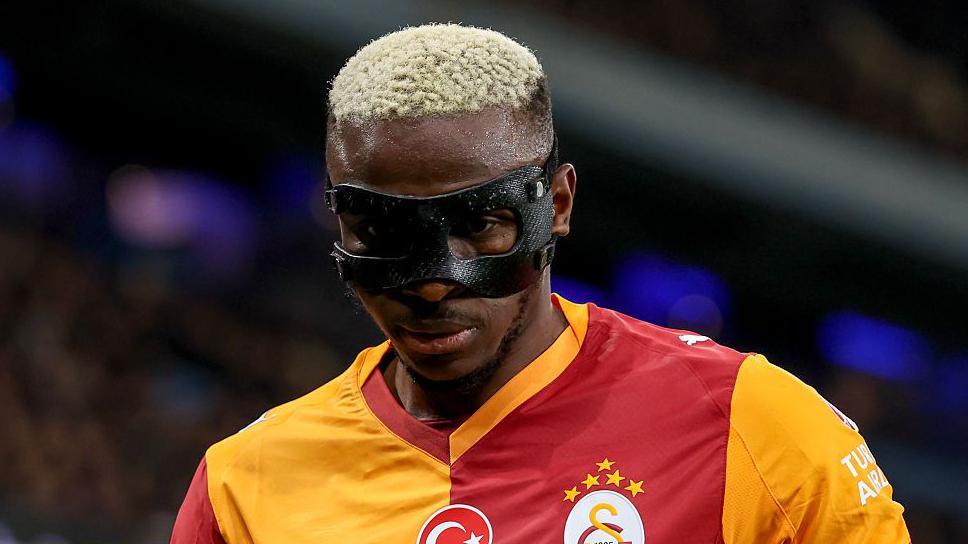
Galatasaray striker Victor Osimhen continues to wear his now-iconic protective mask—but medical experts say it remains essential for his safety following a severe facial injury in 2021.
The Nigeria international sustained multiple fractures to his cheekbone and eye socket during his time at SSC Napoli after colliding with Milan Škriniar in a league match. The injury required extensive surgery, with doctors inserting titanium plates and screws to stabilize the damaged facial structure.
Despite making a full return to football, specialists say Osimhen remains at elevated risk of re-injury due to the nature of the trauma and the permanent implants in his face.
“In cases involving multiple fractures and surgical hardware, the area can remain vulnerable,” a sports medicine expert noted. “Any direct impact could compromise both the bone and the implants.”
Osimhen has previously confirmed the seriousness of his condition, explaining that parts of the hardware extend through his jaw, making it “too dangerous” to play without continued protection.
The mask, commonly used in maxillofacial injury recovery, is designed to reduce the risk of further damage in high-contact sports like football.
Medical experts highlight several key benefits:
- Impact Distribution: The mask spreads the force of any blow across a wider surface, reducing pressure on previously fractured bones.
- Implant Protection: It shields the titanium plates and screws from direct contact, lowering the risk of displacement or complications.
- Injury Prevention: It significantly reduces the chances of secondary fractures in structurally weakened areas.
“The goal is not just recovery, but prevention,” the expert added. “For a player like Osimhen, the mask is a necessary layer of protection.”
Not Just a Temporary Measure
While most footballers wear protective masks only during short-term recovery, Osimhen’s continued use reflects the severity of his injury. Comparable cases, such as Kylian Mbappé—who wore a mask after breaking his nose—are typically temporary and less complex.
Players have also raised concerns about comfort, including restricted vision and heat buildup. Mbappé once described the experience as “an absolute horror,” citing visibility issues during matches.
Safety Over Comfort
Despite these drawbacks, medical professionals agree that the benefits far outweigh the discomfort in high-risk cases. For Osimhen, the mask is not just protective equipment but a critical tool in extending his career and maintaining peak performance.
As a result, what began as a medical necessity has become a defining feature of his presence on the pitch—one rooted firmly in science and player safety.