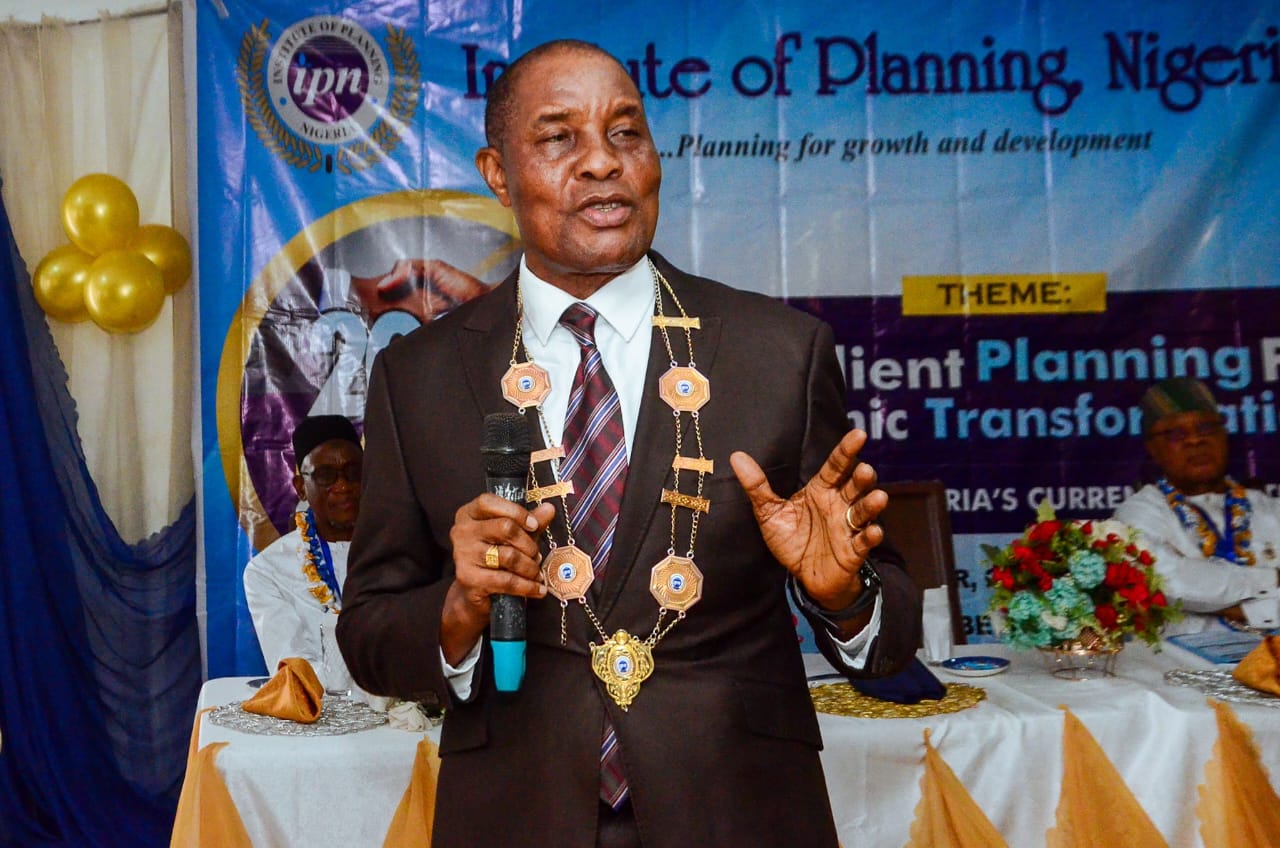
Professional planners in Nigeria have called for a resilient and purpose-driven approach to national development planning, stressing the need to move the country from crisis management to deliberate, productivity-led economic transformation.

The call was made at the 2026 Annual Planners Conference of the Institute of Planning, Nigeria (IPN), held in Abuja with the theme, “Resilient and Purpose-Driven Planning for Economic Transformation: Navigating Nigeria’s Current Realities.”
Delivering the keynote address, Prof. Richard Mayungbe, FIPN, said Nigeria’s economic transformation would depend largely on the ability of policymakers and institutions to translate national aspirations into practical programmes, measurable outcomes and sustainable development.
Mayungbe noted that while recent economic indicators pointed to encouraging signs, aggregate growth alone was insufficient to guarantee improved living standards for Nigerians.
He cited that the Federal Ministry of Budget and Economic Planning has been working with MDAs to finalise the Medium-Term National Development Plan 2026–2030, with stated ambitions including a $1 trillion economy by 2030 and upper-middle-income status by 2050. The significance of this exercise is not the document itself. Its significance lies in whether the plan can create a disciplined system linking national objectives to sector priorities, budgets, institutions, implementation and measurable results.
According to him, the critical question for planners is whether economic growth can translate into increased productivity, jobs, investment, competitiveness and improved welfare.
He said inflation must also be viewed beyond its macroeconomic implications, noting that rising prices directly affect household purchasing power, business planning, public procurement and the cost and feasibility of development projects.
The keynote speaker urged planners to stress-test development plans while ensuring that the emerging medium-term development framework was firmly linked to national priorities, budgets, institutions, implementation mechanisms and measurable results.
Mayungbe outlined a 10-point agenda for transforming Nigeria’s planning architecture, including making plans results-based, integrating plans with budgets, institutionalising risk and scenario planning, developing interoperable planning data systems, strengthening project appraisal, placing productivity at the centre of sectoral plans, protecting human-capital investments, using AI responsibly, institutionalising monitoring and learning, and ensuring continuity across political and administrative cycles.
Earlier, the President and Chairman of the Governing Council of the Institute of Planning Nigeria, Dr. McCarthy Ijiebor, FIPN, said the conference was designed to reposition professional planning as a critical instrument for Nigeria’s economic transformation.
Ijiebor said Nigeria was at a defining crossroads, citing the impact of fuel subsidy reforms, foreign exchange reforms, rising business costs and persistent inflationary pressures.
He lamented that professional planners had for too long been sidelined in policy formulation, resulting in policy documents that often lacked empirical foundations, broad stakeholder input and clear implementation roadmaps.
He said the IPN was advocating a planning framework that would be data-driven, bottom-up, flexible, adaptive and implementable, with clear key performance indicators, realistic timelines and mechanisms for accountability.
The IPN president urged members across the institute’s 21 specialised faculties, including Strategic Management, Project Planning, Health, Education and Corporate Planning, to use the conference to develop practical strategies for building resilient organisations and executable national and sub-national development frameworks.
Adding her voice, Registrar of IPN, Mrs. Gbadamosi Judith said the conference would also provide an opportunity to strengthen collaboration among professional planners, government institutions, academia, the private sector and other stakeholders.
Judith called on members, including 24 newly inducted Fellows, to renew their commitment to evidence-based planning, stressing that sound data and research were essential to building a productive, inclusive and resilient Nigerian economy.